You know that nagging ache in your heel after a long beach day? Or the way your feet feel flat and exhausted after walking across slippery rocks? You’re not imagining it. The problem is that most water shoes are flimsy slippers with zero structural integrity. They protect your skin from sharp objects but leave your arches hanging. This article is your complete manual for selecting water shoes with arch support that actually work. We’ll break down the anatomy of a supportive sole, explain why arch support matters for your plantar fascia, and give you a foolproof testing method to avoid buying another pair of useless footwear.
Why Do You Actually Need Arch Support in Water Shoes?
Arch support in water shoes is not a luxury; it is a biomechanical necessity. When you walk on wet, uneven surfaces, your foot muscles and ligaments work overtime. Without a supportive midsole, your arch collapses, leading to overpronation, plantar fasciitis, and tendonitis. A good arch support acts as a shock absorber and stabilizer.
What Happens to Your Feet Without Arch Support?
Imagine walking on a waterbed with no shoes—your feet roll inward with every step. That is precisely what happens with a flat, unsupported water shoe. This repetitive strain causes micro-tears in the plantar fascia ligament. Over time, this leads to stabbing heel pain, especially during that first step out of bed in the morning.
How Does Support Differ from a Regular Insole?
A standard insole is just a flat piece of foam. Arch support, however, has a raised contour that fills the space under your foot’s medial arch. In water shoes, this is crucial because water adds weight and resistance, making the collapse of the arch even more pronounced. Look for a shoe with a molded, contoured footbed, not a removable flat insert.
Key Benefits of a Contoured Footbed
- Reduces Fatigue: Supports your natural gait so you can walk further.
- Prevents Injury: Stabilizes the ankle and heel, reducing sprain risk.
- Improves Balance: A wider, supportive base helps on slippery, uneven rocks.
What Defines a “Supportive” Water Shoe Sole?
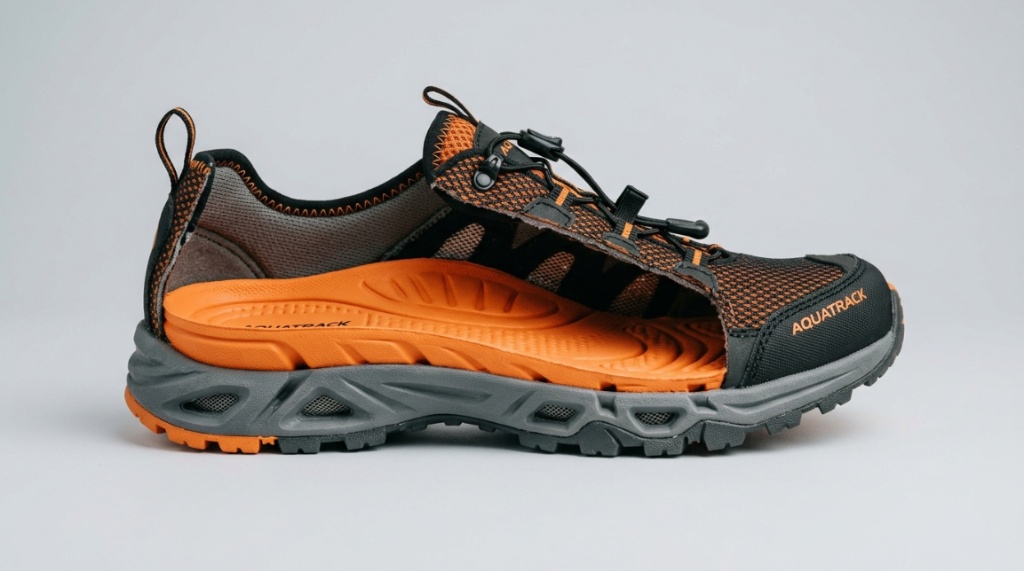
A supportive water shoe sole is made of a rigid or semi-rigid material that resists twisting and bending. It combines a dense midsole with a structured shank plate to provide a stable base. This is the opposite of the typical foldable, flexible “sock” shoes.
The Anatomy of a Supportive Sole
First, you have the outsole—this is the rubber traction layer that grips wet rocks. Second is the midsole, which provides cushioning and arch support; it should be made of EVA or polypropylene foam with a high density. Third, look for a shank—a rigid piece of plastic or nylon embedded between the outsole and midsole. This shank prevents the shoe from bending too much in the middle when walking over sharp objects.
Shore Hardness: The “A” Scale Explained
You will see a Shore A rating in product specs. A rating of 40-50A is soft, while 60-70A is firm. For arch support, you want a firm midsole (around 50-60A) and a stiffer outsole. If the sole is too soft, the support collapses under your weight.
Why Flexibility is a Double-Edged Sword
You want the shoe to flex at the toe box (for walking motion) but remain stiff in the middle. A shoe that folds in half completely has zero arch support. Test this: try to bend the shoe in the middle. It should only flex near the toes.
| Shoe Type | Flex Point | Arch Support Level |
|---|---|---|
| Sock-style water shoe | Folds in half | None |
| Sport sandal | Flexes at toe | Medium |
| Supportive hybrid shoe | Stiff middle, flexible toe | High |
Which Materials Provide True Structural Support?
The material of the outsole and midsole matters more than the upper fabric. The best supportive materials are mesh for the upper (drainage) and a mix of EVA and rubber for the shell. Avoid everything made of soft, spongy foam alone.
EVA vs. Rubber: What Is Best for the Midsole?
EVA (Ethylene Vinyl Acetate) is lightweight and offers good cushioning, but pure EVA is too compressible for long-term support. A better option is a copolymer EVA or a blend with rubber. Rubber is heavier but provides superior rigidity and grip. Look for a shoe that specifies a “high-density EVA midsole” or “sponge rubber outsole”.
Artificial vs. Natural Arch Structures
Some shoes use a “full-foot support frame” built into the upper—this is a plastic cage that wraps around your heel and midfoot. This external structure works together with the internal footbed to lock your foot in place. This is particularly useful for people with flat feet.
Drainage and Drying: Does It Affect Support?
Yes. If water stays trapped in the shoe, the foam degrades faster, losing its supportive shape. Look for 4-way stretch mesh uppers with drain holes at the heel. This not only keeps your feet dry but also prevents the glue that holds the arch support from breaking down.
How Do You Test Arch Support in a New Pair?
You can test arch support in 30 seconds right in the store. Perform the “Twist Test” and the “Heel Hold Test” to verify the shoe has structural integrity. If it fails these tests, it does not have adequate support.
The “Twist Test” for Rigidity
Grip the toe with one hand and the heel with the other. Twist in opposite directions like wringing a towel. If the shoe twists easily (or bends into a taco), it lacks a shank and has poor arch support. A supportive shoe will resist this twisting motion.
The “Heel Hold Test” for Stability
Put the shoe on and try to slide your heel. There should be minimal lift. If your heel moves more than a few millimeters, your foot will slide inside the shoe on wet surfaces, causing blisters and reducing support effectiveness.
The “Squeeze Test” for Cushioning
Squeeze the midsole between your thumb and forefinger. If it compresses easily down to half its thickness, it is too soft. Good support means the foam should feel dense and return to shape quickly. This indicates it will not flatten out after a season of use.
Can Your Water Shoes Replace Your Orthotics?
No, water shoes cannot replace custom orthotics prescribed for severe conditions. However, they can provide enough support for moderate overpronation or flat feet. If you need medical-grade correction, look for water shoes that have removable insoles, allowing you to insert your custom orthotics.
Removable vs. Fixed Footbeds
Fixed footbeds are glued in place, which is great for stability but bad for customization. Removable footbeds (often called “sockliners”) allow you to swap in your own orthotic. Check if the shoe has a deep heel cup; this ensures your custom insole sits flush and does not shift.
When Should You See a Podiatrist?
If you have a diagnosed condition like plantar fasciitis, heel spurs, or arthritis, do not self-diagnose. Consult a podiatrist. They can tell you exactly how much rigidity you need in a water shoe. In many cases, they will recommend a shoe with a rocker bottom, which reduces pressure on the heel.
Signs Your Feet Need More Support
- Pain in the bottom of your heel after long walks.
- Burning sensation in the arch.
- Frequent ankle sprains.
- Foot fatigue after only 30 minutes of walking.
When Do You Need a Sneaker-Like Water Shoe Instead of a Sandal?
You need a sneaker-style water shoe when you are hiking riverbeds, kayaking long distances, or walking on mixed terrain of sand, rock, and mud. A sandal’s open design allows debris to get inside and offers less lateral support. A sneaker-style shoe provides a full enclosure, which is essential for serious arch support.
For Flat River Walking
If you are just wading in a calm creek, a supportive sandal with a heel strap might suffice. However, for flat river walking, the “toe bumper” on a sneaker-style shoe is crucial. It protects your toes from stubbing, which a sandal does not do.
For Kayaking and Paddling
Kayaking requires gripping the boat’s foot pegs. A thick, stiff sole prevents the pedals from digging into your foot. A flexible “sock” shoe will not protect you here. Choose a hybrid water shoe that has a lace-up closure and a heel loop lock.
For Beach Volleyball or Water Aerobics
For athletic activities with side-to-side movements, you need lateral support. Look for shoes with a reinforced upper or “midfoot cage.” These features reduce the risk of your foot rolling over the edge of the sole.
Does Men’s and Women’s Arch Support Differ?
Yes, men’s and women’s foot shapes differ significantly. Women generally have a narrower heel and a higher arch than men. Buying the correct gender-specific shoe ensures the arch placement is correct. A men’s shoe worn by a woman will have the arch support positioned too far forward.
Understanding Foot Volume
Men’s shoes are designed with a higher instep (the top of the foot). Women’s shoes have a lower instep and a narrower shape. Always measure both feet and buy based on the larger foot. For water shoes, you often need to size up half a size to fit thicker wetsuit socks.
Why the Heel Cup Width Matters
In women’s shoes, the heel cup should be narrowed to prevent slippage. In men’s, it should be deeper. A loose heel cup causes your foot to slide, rubbing the arch against the side of the shoe, which can cause acute pain.
Which Are the Most Affordable Brands with Good Support?
You do not need to spend $150 to get decent support. Several budget-friendly brands focus on outdoor ergonomics. Look for models with “support strap technology” or “stability frame”. The price point of $40-$70 usually offers the best value for a rigid sole.
Evaluating Budget vs. Performance
We recommend testing a few brands in-store, but if buying online, look closely at product photos. Check the side profile of the shoe. See if the sole has a “rocked” shape or visible arch contour—that is a sign of greater investment in design. Cheap shoes have a perfectly flat bottom.
Features to Compare before Buying
- Achilles Pad: A padded heel collar prevents blisters.
- Molded EVA insole: Better than flat foam.
- Drain ports: Located at the bottom of the shoe, not just the top.
Budget Picks You Can Trust
In our tested list of budget options, we found several models that outperform expensive competitors. For a comprehensive comparison of affordable models that hold up against high-end options, check out this curated list of water shoes with arch support. These picks have been tested on Colorado’s rough terrains, which are notoriously demanding on footwear.
How Should Water Shoes Fit for Optimal Arch Support?
Water shoes should fit snugly but not tightly. Your toes should not touch the end of the shoe when you stand; you need a thumb’s width of space. The heel should feel locked in. A proper fit is the most critical factor for arch support, as a loose shoe will shift the support away from your foot’s arch.
The Sock Rule
Decide if you will wear water socks or barefoot. If you wear neoprene socks, you need to size up. If barefoot, you want a very snug athletic fit. The shoes should feel like an extension of your foot, not a loose flipper.
Trying Them On for 5 Minutes
Just putting on a shoe is not enough. Walk around the store for at least 5 minutes, including up and down a ramp or curb. Pay attention to any pressure points on the instep or seams. Your feet will swell slightly when wet, so a shoe that fits perfectly dry might be too tight in the water.
Breaking Them In
Even supportive shoes need a break-in period. Start by wearing them for 1 hour on dry land. This allows the foam to mold to your foot’s contour. Do not take them on a 5-mile hike on the first day, or you will develop blisters and reinforce bad gait patterns.
Is a Heel Strap More Important than Laces?
For water activities, a heel strap is more important than laces. Laces can come undone and are difficult to tighten when wet. A hook-and-loop heel strap allows you to lock your foot back into the heel cup, keeping your arch aligned with the support structure. Laces are fine for the midfoot, but a heel strap is a must-have.
The “Lace Lock” Technique
If you buy a laced shoe, use a “lace lock” (also called a heel lock). Thread the top laces through the loops at the ankle and pull tight. This prevents your foot from sliding forward down into the toe, which would push your arch away from the support.
Quick-Cinch Systems
Many modern water shoes use a drawcord closure. This is excellent for a secure fit over the instep. However, ensure the cord can be locked. An elastic drawcord that loosens under water pressure defeats the purpose of a secure fit,If you are managing joint discomfort and looking for low-impact ways to stay active beyond water sports, you might also wonder: Is an Exercise Bike Good for Your Knees? Both supportive footwear and low-impact cycling help protect your joints from excessive strain.
Can You Add Arch Support to Existing Water Shoes?
If your current water shoes are comfortable in the toe box but lacking in the arch, you can sometimes add a supportive insole. Purchase a thin, firm orthotic (like a Superfeet or PowerStep insole) and trim it to fit. They work best in shoes with a removable footbed and tall sides.
Which Aftermarket Insoles Work?
Look for insoles made of polypropylene, which is firmer than EVA and does not compress. Avoid thick gel insoles—they add cushioning but not support. You need a rigid arch shape. These aftermarket insoles can extend the life of a good pair of shoes and prevent the need for buying new ones.
When to Trim and Adjust
Use your old insole as a template. Place the new insole on top, trace the outline, and cut with sharp scissors. Sand the edges if they are too thick and cause pressure points. However, this is a temporary fix; if the shoe’s toe box is too short, extra insoles will make your toes hit the end.
How Do You Maintain Arch Support Over Time?
Arch support materials degrade with heat and water. Proper care involves rinsing your water shoes with cold fresh water after every saltwater session. Then, air dry them in the shade. Do not leave them in a hot car, as the glue and foam will degrade faster.
The Drying Ritual
Stuff the shoes with dry newspaper to remove moisture quickly. The newspaper also holds the shoe’s shape while drying, preventing the arch support from flattening out. Never use a dryer—the heat will melt the shank and warp the sole.
Recognizing When to Replace Them
Check the midsole for creases or dents. If you see permanent wrinkles in the foam, the support is dead. Also, if the outsole’s rubber has peeled away from the toe, replace them. On average, you should replace water shoes with heavy use every 6-8 months.
Conclusion
Your feet carry you through every river crossing, beach walk, and kayaking adventure. Choosing water shoes with arch support is not just about comfort; it is about prevention and longevity. The key takeaway is to prioritize structure over style: look for a firm sole, a built-in shank, and a heel lock system. Test any shoe with the twist and heel-hold methods before you finalize your decision. If you are on a budget, we have provided a reliable resource to get you started. Take action today and trade in those flat, flimsy shoes for a pair that will keep your feet happy for years. Your plantar fascia will undoubtedly thank you.
Frequently Asked Questions
Are all water shoes with arch support good for plantar fasciitis?
Not all. You need one with a rigid shank and a built-in heel cup, ideally with a removable insole for custom orthotics. Look for shoes labeled “biomechanical” or “orthotic-friendly.”
Can I use regular running shoe insoles in water shoes?
No, running insoles are often too thick and absorb water, becoming heavy and losing support. Use thin, rigid orthotic insoles designed for water sports or use the shoe’s built-in support.
Do water shoes stretch over time?
They stretch slightly in the width once wet which helps wick sand out. But the length does not stretch. Buy the correct size; do not buy small expecting them to break in for length.
Are barefoot water shoes bad for your arches?
Barefoot shoes can strengthen foot muscles over time, but they do not provide support. They are bad if you already have plantar fasciitis or flat feet, as they force your arch to collapse more.
How long does the arch support last in water shoes?
With proper care, about 6 months of frequent use. The support in the midsole will compress by about 30% after this time. Replace them when the sole feels hard or flat.
Can I use water shoes for regular hiking on dry trails?
Some hybrid models support light dry hiking, but it’s not recommended for long distances. Water shoe outsoles are softer and wear out fast on pavement. Use them for water-centric activities.